Building a Scalable Random Video Chat Platform with WebRTC, Socket.io, and Redis
Project context
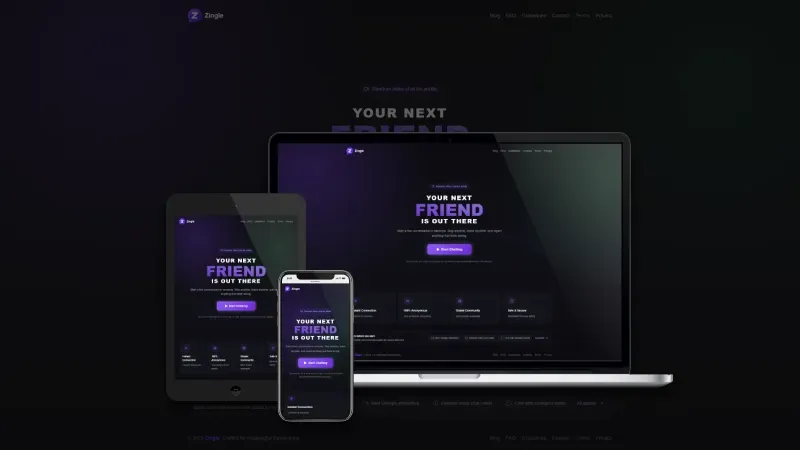
Zingle is a private random video chat platform inspired by services like Omegle, but designed with a stronger focus on scalability, moderation, and real-time performance.
Role: Full-Stack Developer. Tech stack: Next.js, TypeScript, WebRTC, Socket.io, Redis, TURN/STUN, and Docker.
Instead of simply connecting two browsers together, the application is designed as a group of distributed services that work together to provide low-latency video communication, reliable matchmaking, and production-ready infrastructure.
Architecture overview
The backend separates signaling from media transport. Socket.io exchanges signaling events, while WebRTC carries the actual audio and video streams directly between users whenever possible.
1Next.js Client2 |3Socket.io + HTTPS4 |5API / Signaling6 |7Redis Queue + Session Store8 |9Matchmaking Logic10 |11WebRTC Signaling12 |13Browser A <---- STUN / TURN / ICE ----> Browser B14 |15Peer-to-peer media when direct connectivity succeedsWebRTC video chat flow
1. User joins the queue
When a user starts chatting, the client sends a queue request to the server. The server places the user into a waiting queue while keeping lightweight metadata such as region or preferred language.
1Client2 |3queue:join4 |5Server6 |7Redis Queue2. Matchmaking
When another compatible user becomes available, the server removes both users from the waiting queue, creates a temporary room, and tells both clients that a match has been found. At this stage, no media has been exchanged yet.
3. Signaling
Once matched, Socket.io exchanges SDP offers, SDP answers, and ICE candidates so both browsers can negotiate the best peer connection path.
1Browser A Browser B2 | |3 |---- Offer ------>|4 |<--- Answer ------|5 |-- ICE Candidate->|6 |<- ICE Candidate--|4. Peer connection
If direct connectivity succeeds, audio and video travel directly between both users without passing through the application server. This reduces latency and lowers bandwidth costs.

Photo by Andrew Kliatskyi on Unsplash.
5. TURN fallback
Not every network allows peer-to-peer communication. Corporate networks, carrier-grade NAT, and restrictive firewalls often require media relaying through a TURN server.
1Browser A2 |3TURN Server4 |5Browser BSocket.io matchmaking and signaling
Socket.io acts as the real-time communication layer for everything except media transport. It handles queue joins, queue exits, skip events, room creation, signaling data, reports, moderation events, and connection recovery.
Keeping signaling separate from media lets each layer scale independently. The application servers coordinate state and negotiation, while browsers or TURN infrastructure handle the media path.
Redis presence and queue management
Redis is the shared source of truth for active real-time state. Instead of storing active users in application memory, multiple server instances can coordinate through Redis.
Typical Redis responsibilities include online presence, waiting queues, active room tracking, temporary matchmaking state, and distributed session coordination.
1User connected2 |3Redis presence4 |5Join queue6 |7Redis waiting queue8 |9Match found10 |11Remove from queue12 |13Create roomTURN and STUN infrastructure
Reliable WebRTC applications require ICE servers. STUN helps browsers discover their public network address, while TURN guarantees connectivity when a direct peer-to-peer route cannot be established.
A production deployment usually needs geographically distributed TURN servers, TLS support, authentication, relay usage monitoring, and bandwidth cost tracking.
TURN traffic can become one of the largest operational costs in a video platform, so relay usage needs to be observed and managed carefully.
Moderation and reporting
A random video platform needs more than video streaming. Safety is part of the core architecture, not a feature that can be bolted on later.
The moderation system includes user reports, structured report reasons, optional evidence collection, client-side cooldowns, server-side review workflows, and session-based incident tracking.
1User reports partner2 |3Socket.io event4 |5Backend validation6 |7Moderation queue8 |9Review and enforcementScaling strategy
The platform is designed to grow beyond a single server. Application servers stay stateless wherever possible, Redis coordinates shared state, and additional API instances can be added behind a load balancer.
1Load Balancer2 |3API 1 + API 2 + API 34 |5RedisTURN servers are deployed and scaled independently from application servers because media relay consumes far more bandwidth than signaling or matchmaking.
Deployment
The platform is designed for containerized deployment. A typical production stack includes a load balancer, reverse proxy, application servers, Redis, and TURN/STUN infrastructure.
Containerization keeps environments consistent, simplifies deployments, supports rolling updates, improves portability, and makes horizontal scaling easier.
Key engineering takeaways
Building a production-ready random video chat platform extends far beyond establishing a WebRTC connection. It requires system design across networking, real-time communication, distributed state, and user safety.
The main lessons are clear: separate signaling from media transport, use Redis as a shared coordination layer, treat TURN infrastructure as critical production infrastructure, build moderation into the product from the beginning, and keep services stateless enough to scale behind a load balancer.
Did you enjoy this article?

Digital Horizons: A Glimpse into Tomorrow
Dive into the marvels of modern innovation, where the only constant is change. A journey where pixels and data converge to craft the future.

Global Gaze: Beyond the Headlines
Explore the untold and overlooked. A magnified view into the corners of the world, where every story deserves its spotlight.

Dollar and Sense: The Financial Forecast
Money isn't just currency; it's a language. Dive deep into its nuances, where strategy meets intuition in the vast sea of finance.